
- Why Farm-to-Fork Matters for Food Security: A Complete Guide
- The Missing Link in India's Food Security Journey
- What is Farm-to-Fork?
- The Current State of India's Food Supply Chain
- Why Farm-to-Fork Matters for Food Security
- Government Initiatives Supporting Farm-to-Fork
- Real-World Examples of Farm-to-Fork Success
- Innovations Powering the Farm-to-Fork Transition
- Challenges to Scaling the Farm-to-Fork Model
- Frequently Asked Questions
- What does farm-to-fork mean in the Indian context?
- How does farm-to-fork improve farmer incomes?
- What is the ODOP scheme?
- How much food is wasted in India annually?
- What is the government doing to promote farm-to-fork?
- Why are cold chains important for farm-to-fork?
- What is the farmer's share of the consumer rupee?
- Conclusion
Why Farm-to-Fork Matters for Food Security: A Complete Guide
India grows enough food to feed its population. Yet, millions remain vulnerable to food insecurity. At the same time, tonnes of perfectly edible produce are lost every day . This paradox defines the current state of India’s food system.
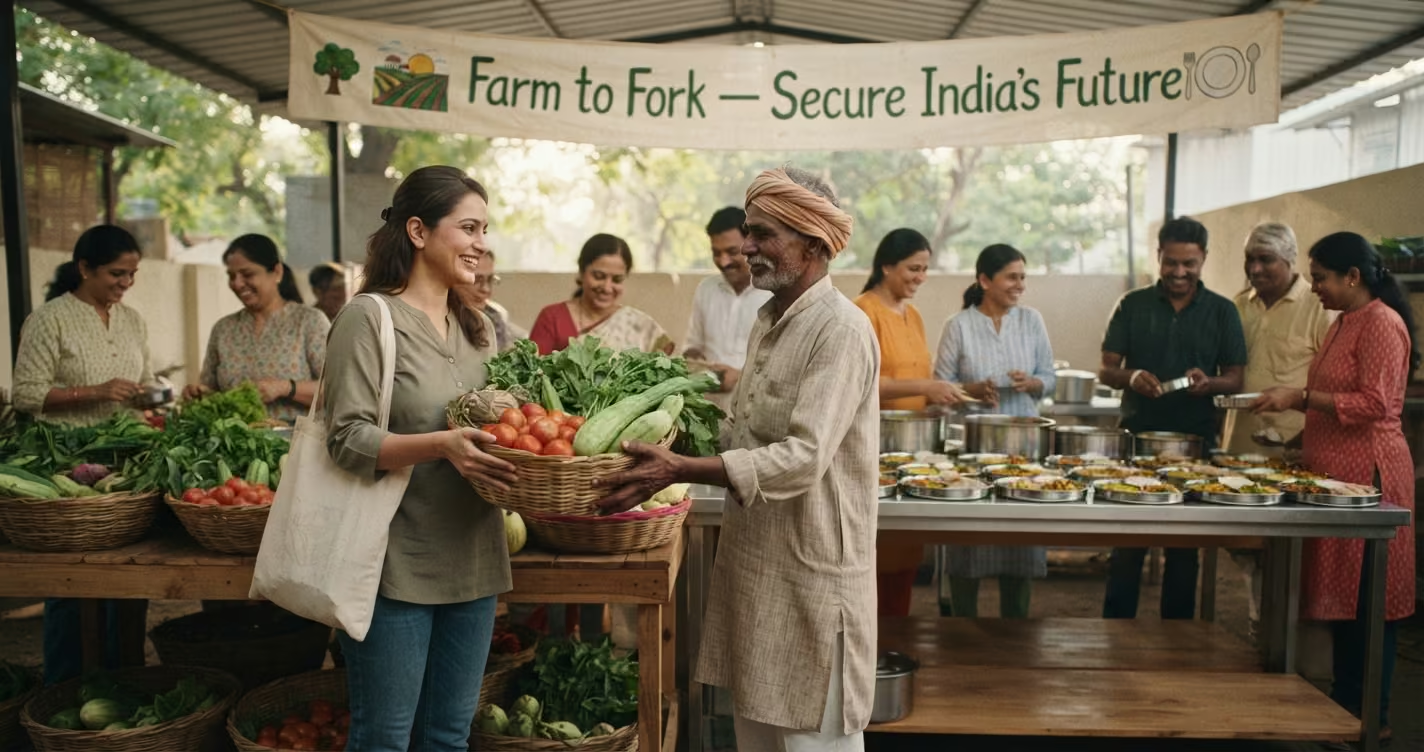
The farm-to-fork model offers a solution. It connects farmers directly with consumers by integrating production, supply chains, and retail . This approach reduces waste, ensures fresher produce, and helps farmers earn better value for their work.
This guide explores why farm-to-fork matters for India’s food security, examining the challenges, opportunities, and real-world initiatives transforming the country’s food landscape.
The Missing Link in India’s Food Security Journey
Public debate around food waste often focuses on consumer behaviour—elaborate weddings, restaurant leftovers, or household waste. While these factors contribute, they overlook a more fundamental issue: a significant portion of food is lost long before it reaches the consumer .
Nearly 78.2 million tonnes of food is wasted annually in India, eroding farmer incomes, straining natural resources, and limiting access to food . The problem is not a lack of food production. It is the inability to preserve and move food efficiently.
The Ripple Effects of Food Loss
| Impact Area | Consequence |
|---|---|
| Farmer Incomes | Produce loses value before generating income |
| Natural Resources | Wasted water, energy, land, and labour |
| Climate Change | Methane released from decomposing food in landfills |
| Food Security | Reduced availability of affordable nutritious food |
Every kilogram of food that never reaches the consumer represents wasted resources invested in its production . India’s food loss problem is not merely a waste management concern. It is a food security, climate, and farmer income challenge that requires urgent attention.
What is Farm-to-Fork?
Simply put, farm-to-fork is about creating a direct, efficient, and transparent journey of food from the farmer’s field to the consumer’s plate . It reduces unnecessary middlemen, shortens supply chains, and ensures fresher produce reaches consumers.
In the Indian context, farm-to-fork has taken on new meaning. It is the creation of an integrated value chain that allows farmers to get farm produce with value-addition to our tables . Government initiatives like e-NAM, PM KISAN SAMPADA Yojana, and PMFME are pushing this model forward.
Key Elements of a Farm-to-Fork System
- Direct Market Linkages: Farmers connect directly with retailers and consumers.
- Value Addition: Processing, branding, and packaging at origin.
- Traceability: Consumers can track produce back to its source.
- Efficient Logistics: Cold chains and temperature-controlled transport.
- Reduced Intermediaries: Fewer middlemen, better farmer prices.
Long considered a European model, farm-to-fork is now gaining traction in India as a blueprint for agricultural resilience and food security .
The Current State of India’s Food Supply Chain
India faces several challenges across the entire food supply chain, from farm to fork. These include fragmented supply chains, lack of storage facilities, high use of pesticides, poor quality of inputs, and significant food loss and waste .
Storage and Cold Chain Gaps
Small farmers often lack access to scientific storage, temperature-controlled logistics, and reliable market linkages. Consequently, perfectly consumable food loses quality and value before reaching buyers .
The Department of Horticulture, Government of Haryana, is leading an initiative to establish a “Centre of Excellence on Sustainable Crop Post-Harvest Management and Cold-chain” (CoE-SPMCC) in Panchkula. This centre will develop infrastructure and best practices for sustainable cold chains .
Between 8 to 20% of horticulture produce (equivalent to 156 million USD) is lost in Haryana alone . These losses extend through the entire supply chain, underlining that cold chains are critical infrastructure for a well-functioning food system.
Price Gaps Between Farmers and Consumers
A working paper by the Reserve Bank of India revealed a stark reality: tomato farmers receive only 33.5% of every rupee a consumer spends. Onion farmers receive 36%, and potato farmers receive 37% .
Farmer Share of Consumer Rupee
| Commodity | Farmer’s Share |
|---|---|
| Tomatoes | 33.5% |
| Onions | 36% |
| Potatoes | 37% |
| Eggs and Chana | 75% |
This gap erodes farmer incomes and makes food expensive for consumers. Agriculture minister Shivraj Singh Chouhan recently announced a committee to reduce this gap, suggesting shared transport costs between Centre and states to lower consumer prices .
Fragmented Landholdings
India’s agricultural sector is dominated by small and marginal farmers, who account for 68.5% of farm holdings. Fragmented landholdings make uniform adoption of modern practices slower .
Why Farm-to-Fork Matters for Food Security
1. Reducing Post-Harvest Losses
India’s post-harvest losses are estimated at 30-40% . Farm-to-fork supply chains directly address this by improving storage, transport, and processing.
Cold chains are often seen as a logistics requirement. In reality, they are a critical link between agricultural production and consumer access. They extend shelf life, reduce spoilage, improve quality retention, and allow producers to access distant markets .
When supported by integrated logistics networks, temperature-controlled transportation, and seamless coordination, cold chains help ensure that perishable products move faster, travel farther, and retain their value for longer .
2. Boosting Farmer Incomes
The farm-to-fork model helps farmers realise better prices by reducing intermediaries and adding value to their produce . Digital marketplaces enable farmers to sell directly to retailers, restaurants, and even households .
For farmers, watching a part of their hard-earned produce lose value before generating income is devastating . Farm-to-fork systems prevent this loss by connecting farmers with markets and ensuring economic incentives .
3. Improving Food Safety and Traceability
Consumers today want to know where their food comes from. Blockchain and QR code-based systems are bringing transparency, allowing buyers to track produce back to its origin .
Food value chains encompass the full range of activities that bring food from farm to plate. Value is added and maintained at every step—production, processing, distribution, marketing, and consumption . Strong value chains for diverse crops are integral to making nutritious foods more accessible, available, and affordable .
4. Promoting Nutrition Security
While India has been able to meet food security, the country has not achieved nutrition security. It suffers from both malnourishment and over-nutrition related illnesses .
TCI researchers say that diversification is key to overcoming India’s high malnutrition rates and making its food system resilient in the face of climate change. However, value chains for non-staple crops need strengthening .
The Tata-Cornell Institute for Agriculture and Nutrition (TCI) is mapping and analysing value chains for coarse grains, horticultural produce, pulses, and oilseeds, focusing on millets, tomatoes, pulses, and soybeans .
5. Environmental Sustainability
The farm-to-fork approach supports sustainable practices—organic farming, precision irrigation, and reduced pesticide usage, ensuring food is safe and environmentally responsible . When discarded food decomposes in landfills, it releases methane, a greenhouse gas far more potent than carbon dioxide .
Government Initiatives Supporting Farm-to-Fork
Pradhan Mantri Kisan SAMPADA Yojana (PMKSY)
This scheme aims to create modern infrastructure with efficient supply chain management from farm gate to retail outlet. It includes storage, transportation, and value addition, helping provide better returns to farmers and reducing wastage . The scheme has a total outlay of ₹6,520 crore .
Production Linked Incentive Scheme for Food Processing Industry (PLISFPI)
This scheme incentivises the food processing sector to expand capacity. The total outlay is ₹10,900 crore .
PM Formalisation of Micro Food Processing Enterprises (PMFME)
Launched in 2020 under the Aatmanirbhar Bharat Abhiyan, the PMFME scheme follows the “one district, one product” principle for food products . It was allocated a total budget of ₹10,000 crore for 2020-2025 .
What PMFME Does
- Product Identification: Each district identifies one food product with a strong local production base .
- Infrastructure Support: Farmers, FPOs, cooperatives, and SHGs can access support for infrastructure, branding, and marketing .
- National Branding: Develops national brands like Madhumantra for multiflora honey from Saharanpur .
In February 2024, the Ministry of Food Processing Industries released the ODOP list covering 713 districts across 35 states and Union Territories .
Mega Food Parks
India now boasts 24 operational Mega Food Parks with a cumulative processing capacity exceeding 4 million metric tonnes, along with 71 agro-processing clusters, nearly 400 cold chain projects, and over 200 food testing laboratories .
More than 1,700 projects have been sanctioned under various government programs, backed by over ₹6,700 crore in subsidies, leveraging an estimated ₹30,000 crore in private investment .
Real-World Examples of Farm-to-Fork Success
Amul: From Poor Man’s Milk to Global Brand
Amul has transformed its image from a poor man’s milk supplier to a globally competitive dairy brand. It has taken on multinationals at every step, entering markets like branded chocolate where it now sells every possible version at affordable prices .
Godrej Agrovet: Value-Added Poultry
Companies like Godrej now control the whole supply chain, from breeding to distribution, assuring quality and safety in chicken processing. From poultry farm to customers’ plates, high-end technology ensures contactless cutting, packaging, and transportation .
Branded Atta Market
India’s branded wheat flour market is now estimated at around ₹20,000 crore annually, with companies like ITC dominating . The shift toward branded packaged products reflects changing consumer habits and preferences for convenience and hygiene.
UP’s One District One Product (ODOP)
Mentha (mint) has been identified for Barabanki, Rampur, and Sambhal. Aonla (Indian gooseberry) for Amethi, Fatehpur, and Pratapgarh. Mango for Lucknow, Mau, and Sitapur. Kala Namak rice for Gorakhpur, Maharajganj, and Siddharthnagar .
The idea is to move beyond selling a product simply on the strength of where it comes from. Processing, packaging, branding, and organised marketing can help turn a locally important product into something that can be sold to consumers in larger domestic markets .
Innovations Powering the Farm-to-Fork Transition
Digital Marketplaces
Apps and platforms enable farmers to sell directly to retailers, restaurants, and even households, ensuring fair pricing and wider market access .
Cold Chain Infrastructure
Investments in refrigerated transport and storage are helping reduce wastage and extend the shelf life of perishable items like fruits, vegetables, and dairy .
Food Traceability
Blockchain and QR code-based systems bring transparency, allowing buyers to track produce back to its origin .
Agri Fintech
Digital payments, crop insurance, and easy access to credit are strengthening farmers’ participation in modern food supply systems .
AI and Smart Technology
AI tools and smart scales track waste in real time. Some hotels have reduced waste by 50–90% using technology .
Challenges to Scaling the Farm-to-Fork Model
For all its promise, scaling farm-to-fork in India faces significant challenges:
- Infrastructure gaps in rural areas .
- Digital literacy challenges among small and marginal farmers .
- High upfront costs for cold storage and logistics .
- Fragmented landholdings making uniform adoption slower .
- Lack of standard guidelines and low awareness among stakeholders .
- Absence of financially viable business models for cold chains .
- Insufficient market connectivity for perishable produce .
Solving these challenges will require collaboration between farmers, start-ups, corporates, and policymakers .
Frequently Asked Questions
What does farm-to-fork mean in the Indian context?
Farm-to-fork means creating an integrated value chain that allows farmers to get farm produce with value-addition to our tables. It connects farmers directly with consumers, reducing middlemen and ensuring fresher, more traceable food.
How does farm-to-fork improve farmer incomes?
By reducing intermediaries, enabling direct market access, and adding value through processing and branding, farmers get better prices. Digital platforms enable direct sales to retailers and consumers.
What is the ODOP scheme?
ODOP stands for “One District One Product.” Under the PMFME scheme, each district identifies one signature food product and builds support around it for processing, branding, and marketing.
How much food is wasted in India annually?
India wastes nearly 78.2 million tonnes of food annually, eroding farmer incomes and straining natural resources . Post-harvest losses are estimated at 30-40%.
What is the government doing to promote farm-to-fork?
The government has launched PMKSY (₹6,520 crore), PLISFPI (₹10,900 crore), and PMFME (₹10,000 crore) schemes. These support cold chains, food processing, and value addition infrastructure.
Why are cold chains important for farm-to-fork?
Cold chains preserve perishable produce, reduce spoilage, extend shelf life, and allow producers to access distant markets. Without them, significant food loss is inevitable.
Conclusion
The farm-to-fork model is not just a supply chain concept. It is a blueprint for the future of Indian agriculture and food systems . Addressing the challenges of food loss, farmer incomes, and nutrition security requires strengthening the infrastructure and logistics systems that connect producers with consumers .
India is uniquely placed to become a global hub for value-added food products. It has the agricultural base, a growing domestic market, and an emerging ecosystem of innovation. But to realise this potential, we must ensure that the growth of food processing is balanced, sustainable, and inclusive .
The next phase of India’s food journey is not just about growing more. It is about growing better—processing with purpose, packaging with care, and ensuring every link in the value chain is strengthened .
Let’s Talk Food Systems
Have questions about the farm-to-fork model or how you can contribute to building a more resilient food system? We would love to hear from you.
Connect with us on WhatsApp for a friendly conversation about how we can collectively strengthen India’s food security. Our team is here to help.