
How to Achieve Zero Hunger Through Giving: A Donor’s Guide
You see the contrast every day. Lavish weddings with overflowing buffets. And on the same streets, people searching for their next meal. This painful gap is the reality of hunger in India. But it does not have to be this way.
Achieving zero hunger is possible. The food exists. The systems exist. What is missing is the will to connect them. Your giving can be the bridge.
At Reshine Org, we work every day to close this gap. We rescue surplus food and deliver it to those who need it most. Our experience has taught us that strategic giving creates lasting change. This guide will show you how your generosity can help achieve zero hunger.
Understanding the Challenge: India’s Hunger Paradox
India faces a cruel contradiction. The country produces enough food to feed its population. Yet millions go hungry every day. Understanding this paradox is the first step toward solving it.
The Scale of Hunger in India
According to the United Nations, India has nearly 195 million undernourished people. That is one-fourth of the undernourished population of the world . The 2024 Global Hunger Index ranked India 105 out of 127 countries, citing hunger as a “serious” problem .
The Scale of Food Waste
At the same time, India wastes 55 kg of food per person every year . Globally, one-third of all food produced goes to waste . In India, an estimated 40% of food is wasted annually . Weddings, corporate events, hotels, and restaurants contribute enormous amounts to this waste.
The Environmental Cost
Food waste is not just a moral failure. It is an environmental crisis. When food rots in landfills, it releases methane, a greenhouse gas 80 times more potent than carbon dioxide. Reducing food waste is one of the most effective climate actions we can take .
What Zero Hunger Means (SDG 2)
Zero Hunger is the second Sustainable Development Goal adopted by all United Nations Member States in 2015 . It is a universal call to end hunger, achieve food security, improve nutrition, and promote sustainable agriculture by 2030.
India has made progress in establishing some of the world’s largest food safety nets, including the Public Distribution System and the Mid-Day Meal Scheme. However, significant challenges remain, especially around malnutrition, dietary diversity, and access for the most vulnerable .
A systems approach is required to achieve zero hunger. This means addressing the root causes of food insecurity, not just the symptoms. It also means tackling food waste at every stage of the supply chain.
How Your Giving Helps Achieve Zero Hunger
Your donation can make a meaningful difference. But not all giving is equal. Strategic, informed giving creates the greatest impact.
1. Support Food Rescue and Redistribution
Food rescue is one of the most direct ways to achieve zero hunger. It takes surplus food from businesses, events, and homes and redirects it to those in need.
Why This Works
- It addresses hunger immediately.
- It prevents food from going to landfills.
- It reduces greenhouse gas emissions.
- It creates a circular economy for food.
Real-World Examples
Reshine Organisation operates a hunger alleviation program that serves over 600 meals daily at the BRIMS Government Hospital in Bidar . Since 2017, this program has saved families an estimated ₹6.6 crore in food expenses . By providing meals to patients and their families, Reshine allows them to focus on recovery rather than worrying about their next meal.
The Annadasoha initiative serves 300 meals in the morning and 300 in the evening . On average, a patient stays for about a week, saving roughly ₹100 per day on food . This is a significant relief for low-income families facing medical bills.
Similarly, the Parivartan initiative provides food support to families in slum areas . These families often face economic hardship and limited access to basic necessities. By providing nutritious meals, Parivartan improves health and helps families save money for education and housing.
Large-Scale Impact
Across India, organizations are scaling food rescue efforts:
- Rise Against Hunger India has served over 40 million meals and reached 3.8 million people across the country . The organization distributes fortified, pre-packaged dry meals enriched with vitamins and minerals to vulnerable populations.
- The Akshaya Patra Foundation has served 4 billion meals and currently reaches 2.1 million children daily in 24,482 schools across 16 states . This milestone was commemorated at the United Nations as a model for food security .
- The Robin Hood Army, a volunteer-driven organization, has served over 153 million meals across 406 cities globally . Its “zero funds” approach relies entirely on volunteers collecting surplus food from restaurants, weddings, and events.
2. Support Organizations with a Proven Model
Not all NGOs are equally effective. Your giving should go to organizations with a clear, measurable impact.
What to Look For
| Criterion | What It Means | Why It Matters |
|---|---|---|
| Transparency | Public financials and impact reports | You can verify your donation’s use |
| Measurable Outcomes | Specific metrics (meals served, kg rescued) | You can track your impact |
| Efficiency | Low overhead costs | More money reaches beneficiaries |
| Scalability | Proven model can grow | Your support creates multiplier effects |
| Dignity-Centered Approach | Respects recipients | Ensures sustainable impact |
Reshine’s Model
Reshine Organisation is unique in its approach . It is youth-led, community-driven, and focused on preserving human dignity. The organization has been recognized as a “Public Hero” by Public TV and has received endorsements from leaders including Justice Santosh Hegde, Dr. C.N. Manjunath, and Dr. H.T. Sangaliana .
The organization is certified and accredited, with operations aligned with the UN Sustainable Development Goals . It has served for 1,100+ consecutive days, showcasing remarkable reliability .
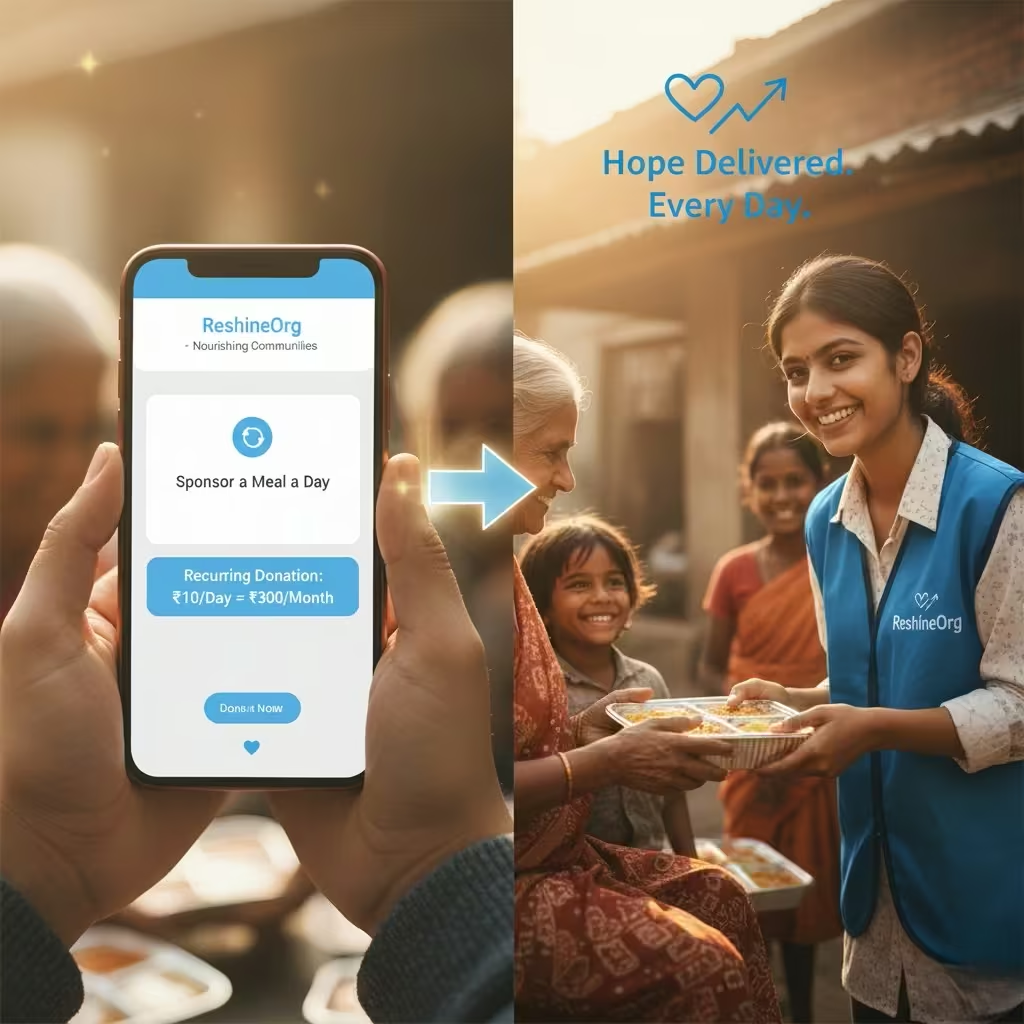
3. Partner with Technology-Driven Solutions
Technology is transforming food rescue. Digital platforms are making it easier to connect donors, volunteers, and recipients.
Swiggy Serves
In 2025, Swiggy launched “Swiggy Serves,” a flagship program to minimize waste and address hunger . The initiative partners with the Robin Hood Army to redistribute surplus food from restaurant partners to underserved communities. The goal is to provide 50 million meals by 2030.
The pilot phase redistributed over 2,000 meals across 33 cities, with more than 126 restaurant partners joining . Brands like Bikkgane Biryani, Dana Choga, and Samosa Singh have signed up. Restaurant partners join by filling out a form on the Swiggy Owner app, and Robin Hood Army volunteers coordinate pickup and distribution.
No Food Waste
The No Food Waste initiative began in Coimbatore with two IT professionals collecting excess food from functions . It has since grown into a nationwide movement. In Hyderabad, the initiative feeds between 1,500 and 1,800 people daily, with 250 volunteers across seven zones .
The organization has mapped 550 to 600 hunger spots in Hyderabad and Secunderabad, including hospitals, bus stations, railway platforms, and old-age homes . It has provided over 3.5 lakh meals since its inception .
Zero Hunger (AI Platform)
A 2025 academic research project developed Zero Hunger, a web-based food donation platform using AI . This Node.js application uses machine learning for fraud detection, food quality assessment, and donor-recipient matching. While still in development, such platforms represent the future of efficient food redistribution.
4. Support Awareness and Education
Achieving zero hunger requires changing attitudes toward food waste. Awareness campaigns educate people about portion control, smart meal planning, and proper storage .
Reshine’s Food Wastage Awareness Program
Reshine conducts workshops, seminars, and educational campaigns in schools and communities . The program teaches people how small changes in daily habits can reduce waste. It also encourages people to donate surplus food rather than throwing it away.
The Power of Community Engagement
Community engagement is critical. Organizations like Reshine have built a strong ecosystem of local partners, including marriage halls, hotels, caterers, and restaurants . Volunteers collect, package, and distribute food efficiently .
5. Give to High-Impact Hunger Alleviation Programs
Consider supporting programs that address hunger from multiple angles:
Annadasoha (Reshine)
Provides daily meals to patients and families at Brims Government Hospital in Bidar. Since 2017, this initiative has provided over 660,000 meals and saved families over ₹6.6 crore .
Parivartan (Reshine)
Provides food support to families in slums, easing financial strain and improving health .
Mid-Day Meal Programs
The PM POSHAN scheme covers over 11.80 crore children across 11.20 lakh schools . Supporting organizations like Akshaya Patra that implement this program reaches millions of children daily.
Real-World Success Stories
Goa’s Corporate Food Rescue
In June 2025, thirteen Goa-based companies were honored for donating surplus food from their canteens through Street Providence . This initiative saved 1 lakh kg of wet waste from landfills and prevented 10,000 kg of plastic from being discarded . The Minister for Factories and Boilers presented certificates, praising the companies for setting an example .
The Rourkela Cold Room Project
Solar-powered cold storage units in Odisha reduced food waste by 31% . Women’s cooperatives managing these cold rooms saw monthly earnings increase from ₹18,000 to ₹90,000 .
Run for Zero Hunger
The Vedanta Pink City Half Marathon in Jaipur saw approximately 15,000 runners supporting the #RunForZeroHunger campaign . This initiative will distribute 1 lakh nutrition packets to children in Nand Ghars across 16 states . The marathon was flagged off by Priya Agarwal Hebbar and Indian women’s cricket team captain Harmanpreet Kaur .
Your Role in Achieving Zero Hunger
You can make a difference. Here is how:
1. Donate Strategically
Choose organizations with transparent models and proven impact. Reshine Org, Akshaya Patra, Rise Against Hunger India, and the Robin Hood Army are all trusted partners.
2. Donate Surplus Food
If you host events, own a restaurant, or have surplus food from your workplace, donate it. Organizations like Reshine will coordinate safe pickup and distribution.
3. Volunteer
Volunteering is a powerful way to contribute. Organizations like the Robin Hood Army operate entirely through volunteers. Reshine welcomes volunteers for food collection, packing, and distribution .
4. Spread Awareness
Share information about food waste and hunger with your network. Awareness is aid. Every conversation plants a seed.
5. Advocate for Policy
Support policies that encourage food donation. The Surplus Food Regulations (2019) made donation legal and encouraged. However, India still lacks Good Samaritan laws to protect donors from liability . Advocacy can close this gap.
Conclusion
Zero hunger is an achievable goal. The food exists. The systems exist. The only missing piece is collective will. Your giving can be part of the solution.
Organizations like Reshine, Akshaya Patra, Rise Against Hunger India, and the Robin Hood Army are already making measurable progress. They rescue surplus food, feed the hungry, and reduce waste. Your support amplifies their impact.
Every meal saved is a life touched. Every donation is a step toward a hunger-free India. The journey to zero hunger begins with each of us.
Your Next Step: Join the Movement to End Hunger
Ready to be part of the solution? Partner with Reshine Org today.
Donate to Reshine and Help Achieve Zero Hunger, Make Your Impact Gift Now
Share This Guide with friends and colleagues who want to make a difference.
Give wisely. Rescue food. Feed families. End hunger.