
- 5 Ways to Improve Food Security for Vulnerable Families
- 1. Grow Nutrition through Kitchen Gardens
- 2. Strengthen Public Distribution Systems (PDS)
- 3. Support Supplementary Nutrition Programs (Take-Home Rations)
- 4. Promote Crop Diversification and Local Production
- 5. Expand Community-Based Childcare and Nutrition Centers
- Frequently Asked Questions
- What is the biggest threat to food security for vulnerable families in India?
- How can I identify vulnerable families in my community who need food support?
- What government schemes should vulnerable families access?
- Why is crop diversification important for food security?
- How does food fortification help improve nutrition?
- Conclusion
5 Ways to Improve Food Security for Vulnerable Families
Food security means more than just having enough to eat. It means having consistent access to nutritious, affordable food that supports health and well-being. For millions of vulnerable families in India, this remains a daily struggle.
India has made remarkable progress. The State of Food Security and Nutrition in the World 2025 report shows that India reduced undernourishment for nearly 30 million people in just two years . Yet, significant challenges remain. Malnutrition, micronutrient deficiencies, and the high cost of healthy diets continue to affect vulnerable communities.
The good news? There are proven, practical ways to improve food security at the household and community level. This guide outlines five impactful strategies drawn from successful initiatives across India.
1. Grow Nutrition through Kitchen Gardens
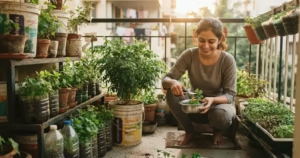
One of the simplest yet most effective solutions is right in people’s backyards. Kitchen gardens provide a sustainable, low-cost source of fresh vegetables and fruits.
How It Works
Kitchen gardens are small plots—often just 12 by 16 feet—where families grow a variety of vegetables, leafy greens, and fruit trees . The Caritas India SAFBIN project demonstrated that even small spaces can produce food continuously throughout the year by using multilayer techniques: tall fruit trees like papaya and drumstick form the upper layer, climbers like beans spread across supports, leafy vegetables fill the ground level, and ginger and turmeric grow beneath the soil.
Real Impact
- Families that once consumed only four or five vegetable varieties in a year began harvesting fifteen to eighteen different crops from their own backyards.
- Children began eating leafy greens regularly, improving their nutritional intake.
- Surplus produce was sold in village markets, allowing women to earn between ₹2,000 and ₹3,000 per month.
- Chemical inputs dropped by more than sixty percent, improving soil health and crop resilience.
CRY has set up over 8,292 kitchen gardens across 12 states, targeting vulnerable communities with high malnutrition prevalence . The initiative includes training on nutrition, hygiene, food preparation, and seed bank development of indigenous, resilient seeds.
How You Can Help
- Support NGOs that promote kitchen gardens in rural and urban slum communities.
- Advocate for kitchen garden programs through local Self-Help Groups (SHGs) and Anganwadi centers.
- Encourage families to start small, even on balconies or in containers.
2. Strengthen Public Distribution Systems (PDS)
India’s Public Distribution System (PDS) is the world’s largest food security program, supporting over 800 million beneficiaries . Recent reforms have made it more efficient and accessible.
Key Reforms That Improve Food Security
- One Nation One Ration Card (ONORC): This scheme allows beneficiaries to lift their entitled food grains from any Fair Price Shop (FPS) across the country using biometric authentication . Since inception, around 191 crore portability transactions have been recorded, making it invaluable for migrant laborers.
- Free Food Grains: The government provides rice and wheat free of cost to Antyodaya Anna Yojana (AAY) and Priority Household (PHH) beneficiaries under PMGKAY.
- Proposed Per-Capita Entitlement: The government is considering shifting AAY households from a fixed 35 kg per family to 7 kg per person per month (capped at 35 kg). This change would benefit larger poor families who currently receive less per capita than smaller households.
Nutrition Focus in PDS
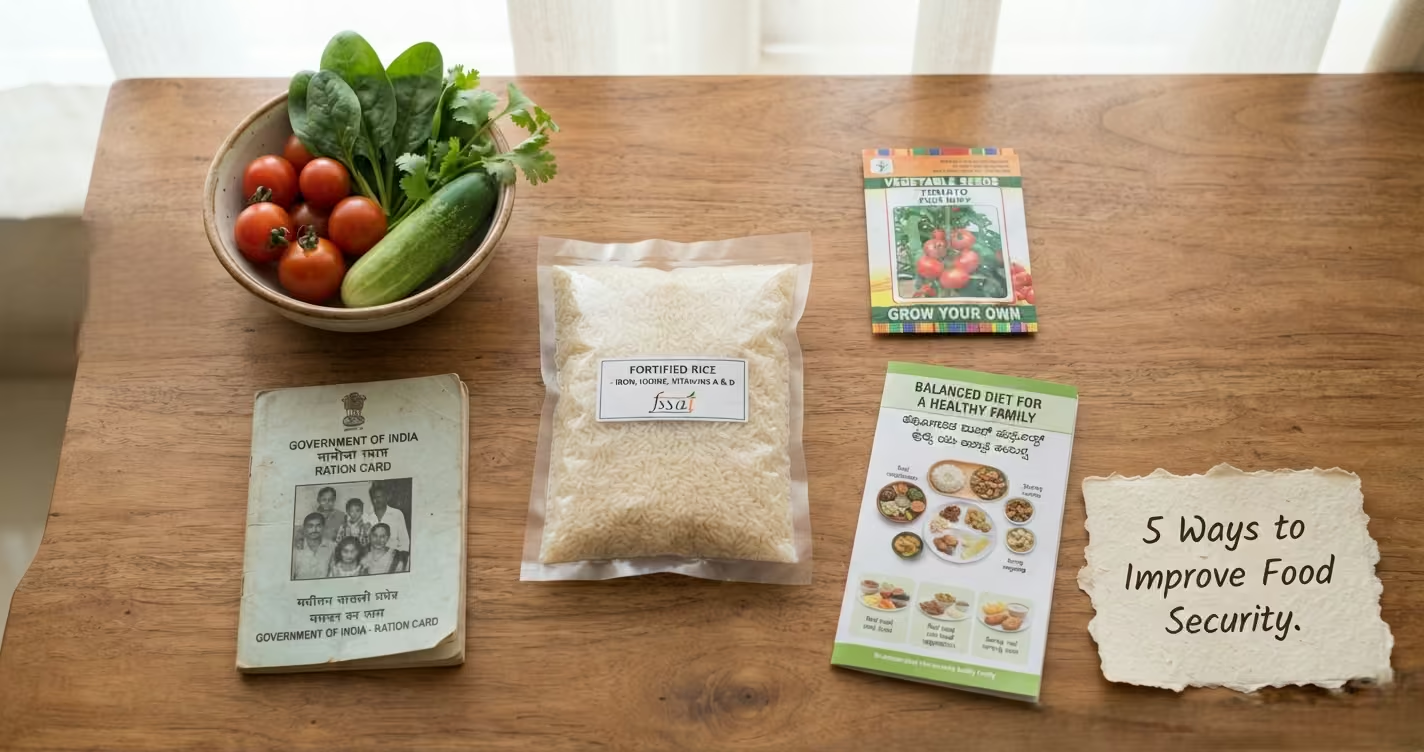
India’s PDS is shifting from mere calorie provision to nutrition-sensitive distribution . The Rice Fortification Initiative ensures that fortified rice (enriched with iron, folic acid, and Vitamin B12) is supplied through all government schemes, including PDS . By March 2024, 100% of rice under central schemes had been fortified.
How You Can Help
- Raise awareness about ONORC so migrant families know they can access rations anywhere.
- Advocate for millet inclusion in PDS. Studies suggest that replacing 1 kg of rice with millets for 200 million PDS beneficiaries would shrink the program’s true cost by US$1.37 billion each year while improving nutrition.
- Support local procurement to strengthen Farmer Producer Organizations (FPOs) and local economies.
3. Support Supplementary Nutrition Programs (Take-Home Rations)
For children under three and pregnant/lactating women, consistent nutrition is critical. These are the “first 1,000 days” when proper nutrition shapes lifelong development . Take-Home Rations (THR) bridge this gap.
What Are Take-Home Rations?
THR provides ready-to-eat supplementary food to children (6 months-3 years) and pregnant/lactating mothers through Anganwadi centers under POSHAN 2.0 . Recent NFSA recommendations have strengthened THR norms with age-specific standards focused on protein and micronutrient adequacy.
Real Impact
In Chhattisgarh’s Manpur block, Sangeeta’s daughter Katyayni was found to be severely malnourished. Through access to ready-to-eat THR, Katyayni began receiving consistent nutrition even while her mother collected mahua flowers in the forest. Workers noted steady weight gain and improved energy levels.
How You Can Help
- Ensure families in your community are aware of Anganwadi services and how to access THR.
- Support organizations working to strengthen THR supply chains.
- Advocate for increased per-beneficiary budgetary allocation for THR programs.
4. Promote Crop Diversification and Local Production
Food security is not just about distribution. It is also about what we produce. India’s agriculture policy has long focused on staples like rice and wheat, leading to dietary monotony and micronutrient deficiencies.
The Case for Diversification
Marginal farmers, who account for 68.5% of farm holdings, remain tied to a narrow basket of crops . Diversifying toward nutrition-rich, climate-resilient crops like millets, pulses, and oilseeds can improve both farmer incomes and family nutrition.
Success Stories
- Farmers in eastern Uttar Pradesh who turned fallow summers into profitable groundnut seasons under the Sujalam Sufalam program.
- Ragi farmers in Odisha now growing millets for both family nutrition and sale.
The Role of Farmer Producer Organizations (FPOs)
FPOs help small farmers aggregate produce, access inputs and credit, negotiate better prices, and move up the value chain . The government has extended the Central Scheme for FPOs for another five years, providing a strong foundation.
How You Can Help
- Support local farmers’ markets and community-supported agriculture.
- Advocate for state-level procurement of millets and pulses for PDS and nutrition programs.
- Encourage local institutions to purchase from FPOs and SHG collectives.
5. Expand Community-Based Childcare and Nutrition Centers
For the most vulnerable families, particularly in tribal and underserved areas, community-based childcare centers are a powerful intervention. They address multiple challenges simultaneously: child nutrition, maternal workload, and early childhood development.
Creches for Malnutrition Management
A case study from the Public Health Resource Society shows that community-based creches (daycare centers) for children under three are highly effective. The intervention includes running creches, community mobilization through Participatory Learning and Action (PLA) meetings, and health systems strengthening.
Measurable Outcomes
- 92.5% of children maintained normal weight-for-height.
- 81.2% maintained normal weight-for-age.
- 70% maintained normal height-for-age.
- 64.6%, 33.3%, and 27.8% of children respectively improved their grades on these indicators.
These centers also allow mothers to work, increasing household income, and help elder siblings attend school.
How You Can Help
- Support NGOs that establish community-based creches in high-need areas.
- Advocate for expansion of creche services under ICDS and other government schemes.
- Volunteer to support existing creches through donations or skill-sharing.
Frequently Asked Questions
What is the biggest threat to food security for vulnerable families in India?
The high cost of healthy diets remains a major barrier. Over 60% of Indians cannot afford nutrient-rich foods due to inflation, poor cold chains, and weak market linkages . Climate change also disrupts crops and wages, adding pressure on rural livelihoods.
How can I identify vulnerable families in my community who need food support?
Start by connecting with local Anganwadi centers, which maintain records of families with malnourished children, pregnant women, and lactating mothers . Community-based organizations and SHGs also have lists of vulnerable households.
What government schemes should vulnerable families access?
Key schemes include the Public Distribution System (PDS) for subsidized food grains , Take-Home Rations through Anganwadi centers , PM POSHAN for mid-day meals in schools , and supplementary nutrition through ICDS.
Why is crop diversification important for food security?
Diversifying toward millets, pulses, and vegetables improves dietary diversity and micronutrient intake. It also supports farmer incomes by providing market opportunities beyond traditional staples.
How does food fortification help improve nutrition?
Fortified rice provides essential micronutrients like iron, folic acid, and Vitamin B12 to populations that rely on staples. This is a cost-effective strategy to reduce micronutrient deficiencies, including anaemia
Conclusion
Improving food security for vulnerable families requires a multi-pronged approach. Kitchen gardens empower families to grow their own nutrition. A strengthened PDS with millets and fortified rice ensures access to quality staples. Take-home rations protect the most critical window of a child’s life. Crop diversification builds resilience and livelihoods. And community-based childcare centers support the most vulnerable children and their mothers.
Each of these strategies has been proven effective in Indian contexts. Each can be supported by individual donors, community leaders, and organizations alike. The path to zero hunger is not a single intervention, but a web of solutions working together.
Let’s Talk Food Security
Have questions about improving food security in your community? Want to share your own initiatives? We would love to hear from you.
Connect with us on WhatsApp for a friendly conversation about how you can help build food security for vulnerable families. Our team is here to help.