

- How to Claim Tax Exemption on Donations: Complete Guide
- Why Understanding Tax Exemption Matters for Donors
- What is Section 80G of the Income Tax Act?
- Eligibility Criteria for Claiming Tax Exemption
- The Two Categories of 80G Deductions
- Step-by-Step Process: How to Claim Tax Exemption
- Common Mistakes to Avoid When Claiming Tax Exemption
- Special Cases and Additional Benefits
- How Reshine Org Simplifies Your Tax Exemption Process
- Frequently Asked Questions About Tax Exemption
- Conclusion: Give Smart, Save Smart, Multiply Your Impact
How to Claim Tax Exemption on Donations: Complete Guide
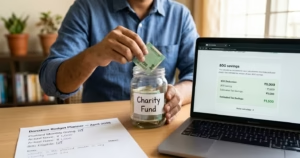
You gave from your heart. You supported a cause that matters. Now, it is time to let the government thank you back. Learning how to claim tax exemption on your donations is a smart financial move. It reduces your tax liability while amplifying your generosity.
Many donors miss this step. They donate generously but forget to save their receipts. Consequently, they lose out on legitimate tax savings. This guide will change that for you.
At Reshine Org, we believe in rewarding your compassion. Every donation you make to us comes with a clear path to tax benefits. We want you to keep more money in your pocket. After all, that money can fund even more good deeds in the future.
Let us walk through the entire process together. You will become an expert in how to claim tax exemption by the end of this article.
Why Understanding Tax Exemption Matters for Donors
Taxes are a fact of life. But smart planning makes them less painful. When you learn how to claim tax exemption correctly, you effectively reduce the cost of your giving.
Think about it this way. A donation of ₹1,000 might only “cost” you ₹700 after tax savings. That is a 30% discount on doing good. Would you say no to that? Probably not.
Furthermore, understanding this process builds trust. It shows you that an NGO is legitimate and registered properly. Without valid 80G certification, no tax benefit exists. Therefore, checking for this status is a vital part of your donor due diligence.
Finally, tax savings can fuel more giving. The money you save on taxes can be redirected into your charity budget for next year. This creates a beautiful cycle of generosity.
What is Section 80G of the Income Tax Act?
Let us start with the basics. Section 80G is a provision in India’s Income Tax Act. It allows donors to claim deductions on contributions made to specific funds and charitable institutions.
In simple terms, the government says “thank you” for your kindness. They reduce your taxable income by the amount you donated (subject to certain limits). Consequently, you pay less tax.
However, not every donation qualifies. The recipient NGO must have valid 80G registration. You cannot claim this benefit for donations to political parties or unregistered groups. Always verify this before you give.
At Reshine Org, we maintain a valid and active 80G certificate. Every donor who supports our food rescue mission is eligible for this benefit. We provide the official receipt you need for how to claim tax exemption successfully.
Eligibility Criteria for Claiming Tax Exemption
Before you jump into the process, check if you qualify. The rules are straightforward for individual donors.
Who Can Claim?
- Individual taxpayers (salaried or self-employed)
- Hindu Undivided Families (HUFs)
- Companies and businesses
What Donations Qualify?
- Cash payments (subject to limits)
- Cheque or demand draft
- Online transfers (NEFT, RTGS, UPI)
- Credit or debit card payments
Important Limits to Remember
- Cash donations above ₹2,000 do NOT qualify. Always use digital or cheque payments for amounts exceeding this limit.
- For most NGOs (like Reshine), you can claim 50% or 100% of the donation amount. We will explain the difference below.
The Two Categories of 80G Deductions
Not all 80G certificates are the same. There are two main categories. Understanding them is essential for how to claim tax exemption accurately.
| Category | Deduction Percentage | Example NGOs |
|---|---|---|
| 100% Deduction (No Limit) | Entire donation amount is deductible | Prime Minister Relief Fund, National Defense Fund |
| 50% Deduction (With or Without Limit) | Half of your donation is deductible | Most registered NGOs including Reshine Org |
Here is a simple example. Suppose you donate ₹10,000 to Reshine Org. We fall under the 50% category. Your taxable income reduces by ₹5,000 (which is 50% of ₹10,000). This saves you roughly ₹1,500 to ₹1,800 in actual taxes, depending on your income slab.
For 100% deduction NGOs, the entire ₹10,000 would reduce your taxable income. The tax saving would be double. However, very few organizations qualify for this highest category.
Step-by-Step Process: How to Claim Tax Exemption
Now we reach the heart of the matter. Follow these steps carefully. Each one matters for a successful claim.
Step 1: Donate Only to Eligible NGOs
This is your first and most critical step. Before you give, check for 80G certification. A legitimate NGO will display this proudly on their website.
At Reshine Org, our 80G number is clearly mentioned on our donation page and in every receipt. You can also verify it on the Income Tax Department’s website. Never donate to an organization that avoids this question.
Step 2: Make Your Donation and Get the Receipt
Always pay through traceable methods. Use online banking, UPI, credit cards, or cheques. Avoid large cash donations as they do not qualify for exemption.
Immediately after your donation, collect the official receipt. This receipt must include:
- Your name and PAN (if donation exceeds ₹2,000)
- NGO’s name and 80G registration number
- Donation amount and date
- Mode of payment
At Reshine, we email this receipt automatically. Save it instantly in a dedicated tax folder.
Step 3: Calculate Your Deduction Correctly
Now you need to do some math. Use the category information from the table above.
Example Calculation for Reshine Donor (50% Category)
- Donation Amount: ₹12,000
- Eligible Deduction (50%): ₹6,000
- Your Tax Slab: 20%
- Actual Tax Saved: ₹6,000 × 20% = ₹1,200
This calculation shows your true cost of giving. You donated ₹12,000, but your net outflow after tax saving is only ₹10,800. That is real value.
Step 4: Fill Out Your Income Tax Return (ITR)
This is where how to claim tax exemption meets action. When you file your ITR, you will see a specific section for deductions under Chapter VI-A.
Look for Schedule 80G or the specific row for donations. Enter the eligible amount you calculated. Keep your receipts handy in case the tax officer asks for proof.
For salaried employees, you can also inform your employer. Provide the donation receipts to your HR or accounts department. They can adjust your TDS (Tax Deducted at Source) accordingly. This means you pay less tax each month rather than waiting for a refund.
Step 5: Maintain Records for Future Scrutiny
The tax department can ask for proof up to six years after you file. Therefore, maintain meticulous records.
Create a simple system. Save all donation receipts in one digital folder. Name each file clearly (e.g., “Reshine_Donation_80G_April2025”). Additionally, keep a spreadsheet tracking your annual donations.
This habit saves massive stress later. It also gives you a beautiful overview of your giving journey over the years.

Common Mistakes to Avoid When Claiming Tax Exemption
Even smart donors make errors. Here are the most frequent pitfalls. Avoid them to ensure a smooth tax filing experience.
Mistake 1: Losing the Receipt
This is the number one error. Without the receipt, you have no proof. Consequently, the tax officer can disallow your claim. Always save your receipts immediately.
Mistake 2: Donating Cash Over ₹2,000
Cash feels easy, but it kills your tax benefit. Any single cash donation above ₹2,000 is not eligible for deduction. Use digital payments for all significant gifts.
Mistake 3: Claiming the Wrong Percentage
Some donors assume every NGO offers 100% deduction. This is incorrect. Verify your NGO’s category before filing. Claiming the wrong amount can trigger a notice from the tax department.
Mistake 4: Forgetting Your PAN
For donations above ₹2,000, you must quote your PAN. Without it, the NGO cannot issue a valid 80G receipt. Ensure your PAN is on every receipt you collect.
Special Cases and Additional Benefits
The 80G deduction is not the only game in town. You should know about other related benefits as well.
Donations to Religious Institutions
Many temples, churches, and mosques are not registered under 80G. Donations to them generally do not qualify for tax exemption. Always check before assuming.
Contributions to Political Parties
These fall under a different section (80GGC). The rules and limits vary. This guide focuses on charitable donations, not political contributions.
Corporate Donations (CSR)
Companies have different rules under the Companies Act. Your personal donations as an individual follow the 80G framework described above.
How Reshine Org Simplifies Your Tax Exemption Process
We designed our donation system with your convenience in mind. Every step of how to claim tax exemption is automated on our platform.
When you donate through our secure portal, you receive:
- An instant automated receipt
- Our valid 80G number printed clearly
- A downloadable PDF for your records
- A follow-up email with tax filing tips
Furthermore, our donor support team answers your tax-related questions. We cannot give you personal tax advice, but we provide all the documentation you need. Your CA or tax consultant will find everything in order.
We also send annual donation summaries in January each year. This helps you prepare for the March 31st financial year deadline. No chasing, no forgetting.
Frequently Asked Questions About Tax Exemption
Can I claim tax exemption for donations made outside India?
Generally, no. Section 80G applies only to donations made to eligible Indian NGOs. Foreign donations may have different tax treatments under other sections.
Is there a maximum limit on how much I can claim?
For most 50% NGOs, there is no upper limit on the donation amount. However, the deduction is capped at 50% of your donation. For 100% NGOs, the entire amount is deductible without a monetary ceiling.
What if I donate to multiple NGOs in one year?
You can claim deductions for all eligible donations. Simply add up the eligible amounts from each NGO. Enter the total in your ITR. Keep separate receipts for each organization.
My donation receipt does not have my PAN. Is it still valid?
For donations of ₹2,000 or less, a PAN is not mandatory. For any amount above ₹2,000, the receipt must show your PAN. Otherwise, the donation is not eligible for deduction. Contact the NGO for a corrected receipt.
How long should I keep my 80G receipts?
Keep them for at least six years from the end of the relevant financial year. For example, a donation made in FY 2024-25 should be kept until March 2031. This matches the standard income tax assessment timeline.
Conclusion: Give Smart, Save Smart, Multiply Your Impact
You now understand how to claim tax exemption like a pro. This knowledge transforms your giving from a pure expense into a strategic financial decision. You save money on taxes. The NGO receives vital funds. The world becomes a better place.
It is a triple win.
At Reshine Org, we are committed to making this process seamless for you. Our transparent systems and automated receipts take the hassle out of tax season. You focus on the joy of giving. We handle the paperwork.
Your Next Step: Give and Save Today
Ready to put this knowledge into action? Make a donation to Reshine Org and experience the complete 80G process firsthand.
Donate Now and Get Your Instant 80G Receipt
Start saving on your taxes while feeding the hungry and protecting our planet. Your generosity deserves this reward.