
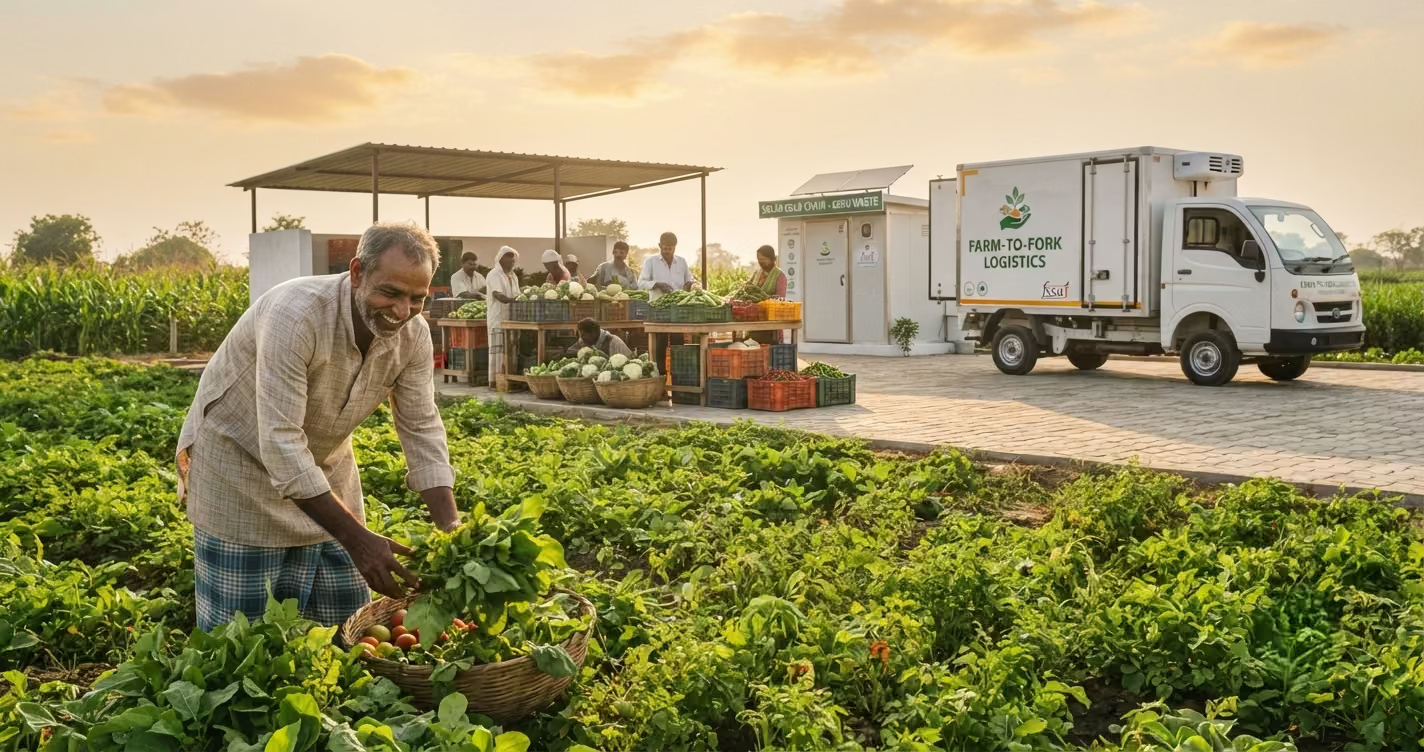

How to Stop Food Loss and Save Resources: A Complete Guide
India produces enough food to feed its population. Yet, millions face food insecurity. This paradox stems not from a lack of production, but from a failure to preserve what is already grown.
Food loss happens at every stage—from farm to fork. Crops rot in fields. Produce spoils during transport. Edible items are discarded at markets and homes. This is not just wasted food; it is wasted water, energy, land, labour, and money.
Stopping food loss is one of the most effective ways to strengthen food security and combat climate change. This guide will walk you through the causes of food loss in India, the resources wasted, and the practical solutions that can make a difference.
The Hidden Cost of Food Loss in India
India’s food loss challenge is immense. The country generates 78.2 million tonnes of household food waste each year, according to the Food Waste Index Report 2024 . This figure does not include losses that occur earlier in the supply chain—during harvesting, storage, transport, and processing.
Post-harvest losses across agricultural produce are estimated at significant levels. An ICAR-CIPHET study found losses ranging from 4.65–5.99% for cereals to as high as 15.88% for fruits . A 2022 NABCONS study shows similar patterns, with fruit losses at 6.02–15.05% and vegetable losses at 4.87–11.61% .
For a single commodity, the scale is startling. India produces over 40% of the world’s mangoes—about 22.40 million tonnes in 2023. Yet, total post-harvest losses for mangoes are estimated at a devastating 25–30% of annual output. Average stage-wise losses include 4-8% during harvesting, 5-8.5% in transportation, 3.5-5.7% in storage, and 5-15% at the final retail stage .
Resources Wasted When Food Is Lost
Every kilogram of food lost represents wasted resources :
- Water: The water used to grow wasted food is lost forever.
- Energy: The fuel for tractors, transport, and processing is wasted.
- Land: The soil and space used to produce uneaten food yield no benefit.
- Labour: The effort of farmers and workers is lost.
- Money: Farmers lose income; consumers pay higher prices.
The economic impact is staggering. Studies indicate that India loses agricultural produce worth over ₹1.5 lakh crore every year due to inefficiencies in storage, transportation, processing, and supply chain management .
The Environmental Toll
Food loss is also a climate crisis. When food decomposes in landfills, it releases methane—a greenhouse gas approximately 80 times more potent than carbon dioxide over a 20-year period . Food losses and waste account for 8% to 10% of annual global greenhouse gas emissions .
India’s National Institute of Food Technology Entrepreneurship and Management (NIFTEM) has partnered with Tetra Pak to study greenhouse gas emissions associated with food loss and waste, viewing reduction as both a tool for strengthening food security and a means of lowering the climate impact of the food system .
The Causes of Food Loss: A Stage-by-Stage Breakdown
Understanding where and why food is lost is the first step toward stopping it.
1. On the Farm
Harvesting Losses (4–8% for mangoes) :
- Manual harvesting without proper tools damages produce.
- Lack of scientific picking methods leads to bruising.
- Farmers often leave edible crops in fields due to low market prices or lack of labour.
Lack of On-Farm Storage:
- Temporary or unscientific storage leads to pest infestation, fungal growth, and moisture damage .
- Even a small increase in moisture content can cause aflatoxin contamination in pulses and oilseeds .
Limited Access to Finance:
- Farmers lack working capital to hold inventory or invest in better storage .
- This forces distress sales during peak harvest, when prices are lowest.
2. During Transport
Transportation Losses (5–8.5% for mangoes) :
- Poor packaging leads to mechanical injuries and crushing.
- Inadequate cold-chain infrastructure means perishables spoil in transit.
- Fragmented supply chains increase transit time and handling.
Uneven Cold Chain Distribution:
- While cold storage capacity exists, it is heavily concentrated in select states and commodities (e.g., potatoes) .
- The absence of pre-cooling units, reefer transport, and packhouses results in spoilage before produce reaches markets .
3. At Wholesale Markets
Storage Losses (3.5–5.7% for mangoes) :
- Inadequate infrastructure at wholesale markets.
- Poor handling practices and weak food safety systems.
- Limited waste management capacity .
Fruit and vegetable wholesale markets are major hotspots of food loss and waste. They connect millions of farmers to urban consumers but large volumes of edible food are lost daily due to these inefficiencies .
4. At Retail and in Homes
Retail Losses (5–15% for mangoes) :
- Supermarkets discard food approaching expiry dates.
- Overstocking and poor inventory management.
- Cosmetic standards that reject perfectly edible produce.
Household Waste (60% of total waste) :
- Poor meal planning and over-purchasing.
- Misunderstanding of date labels (Best Before vs. Use By).
- Lack of knowledge about proper food storage.
Per capita household food waste in India is estimated at 55 kg per year, compared to the global average of 79 kg .
Solutions to Stop Food Loss
Stopping food loss requires a multi-pronged approach across the entire supply chain.
1. Adopt the Food Recovery Hierarchy
The U.S. Environmental Protection Agency’s Food Recovery Hierarchy provides a clear framework :
First Priority: Prevention
- Plan meals, buy only what is needed, cook mindfully.
- This is the most effective solution—avoid generating waste in the first place.
Second Priority: Recovery
- Surplus food that is still fit for human consumption should be recovered.
- Donate to food banks, shelters, and community kitchens.
Third Priority: Feed Animals
- Use surplus food as animal feed where human consumption is not possible.
Fourth Priority: Composting and Biogas
- Convert organic waste into compost or biogas.
- In Surat, a 50-tonne-per-day compressed biogas plant converts organic market waste into renewable energy and bio-fertiliser, reducing methane emissions by an estimated 7,500 tonnes annually .
Last Priority: Landfill
- Dumping food in landfills releases methane.
- Incineration contributes to air pollution.
2. Strengthen Post-Harvest Infrastructure
The Indian Council of Agricultural Research (ICAR) has set an ambitious target: reduce food losses during storage, processing, and transportation from the current 15–20% to approximately 5% by 2047 .
Key Technologies from ICAR :
- Hybrid evaporative cooling storage: Extends shelf life of horticultural commodities by 4–5 times compared to ambient storage.
- IoT-based smart solar dryers: Reduce drying time from 6–7 days to 3–4 days with better quality.
- Grain storage bins (250–1000 kg): Protect grains from moisture, insects, and rodents for up to 1 year without significant loss.
- Multi-module onion storage system: Reduces storage losses to less than 15% for 6 months.
Scientific Warehousing :
- Modern warehouses with moisture control, aeration, and fumigation dramatically reduce storage losses.
- Digital warehouse management enables real-time stock monitoring and quality assessment.
- Warehouse Receipt Systems allow stored commodities to be used as collateral, reducing distress sales.
Cold Chain Development :
- The Ministry of Food Processing Industries supports cold chain infrastructure through the Pradhan Mantri Kisan Sampada Yojana (PMKSY) .
- PMKSY includes the Integrated Cold Chain & Value Addition Infrastructure scheme.
- This creates modern infrastructure with efficient supply chain management from farm gate to retail outlets.
3. Invest in Technology
AI and IoT :
- IoT-based sensors monitor temperature, humidity, and gas levels in storage facilities.
- GPS-enabled transport tracking reduces transit delays.
- AI-driven demand forecasting helps predict price trends and optimal selling windows.
Digital Supply Chain Platforms :
- Integrated agri value chain platforms combine storage, finance, risk management, and trade.
- When infrastructure and capital move in tandem, losses decline significantly.

4. Empower Farmers and Producer Organizations
Farmer Producer Organizations (FPOs) :
- Strengthening FPOs helps small farmers aggregate produce and access better markets.
- FPOs can invest in shared infrastructure like packhouses and ripening facilities.
Finance Access :
- Structured trade finance solutions unlock liquidity against warehoused goods.
- Access to timely working capital prevents distress selling.
5. Reduce Waste at the Household Level
The WRI India report emphasises that poor food management and consumer behaviour are key reasons behind food waste .
Simple Household Actions:
- Plan meals before shopping.
- Store food properly to extend shelf life.
- Practice portion control and dine without leaving leftovers.
- Understand date labels (Best Before vs. Use By).
Reviving Traditional Practices :
- Indian kitchens have long practised resourcefulness: leftover rice becomes lemon rice; chapatis turn into upma; dal is reused in parathas.
- Encouraging these practices alongside modern efforts is crucial.
6. Engage the Hospitality and Retail Sectors
Hotels, Restaurants, and Catering (HoReCa) :
- WRAP (Waste and Resources Action Programme) has committed to reducing food waste in India through sector-specific interventions.
- The HoReCa sector will be engaged to develop a food waste strategy.
Supermarkets :
- Standardise storage conditions and packaging according to product categories.
- Adopt food recording and tracking technologies.
- Strengthen collaboration with NGOs for surplus food redistribution.
Food Service Innovations :
- Staff-served meals instead of self-service reduce waste.
- Increasing buffet plate sizes and encouraging takeaway of leftovers.
- Data-driven waste tracking programs to monitor and cut food waste.
7. Support Policy and Public Awareness
Government Initiatives:
- The FSSAI has launched the “Save Food Share Food” initiative and notified the Food Safety and Standards (Recovery and Distribution of Surplus Food) Regulations, 2019, which specify responsibilities for safe food donation .
- The government has advised states to include a chapter on prevention of food wastage in school syllabi to inculcate awareness among young students .
- PM KISAN SAMPADA Yojana provides ₹6,520 crore for creating modern infrastructure with efficient supply chain management from farm gate to retail outlets .
Data and Targets :
- Experts have called for establishing specific and measurable national targets for reducing food loss and waste.
- More accurate statistics across regions and supply chain stages are needed to identify problem areas.
City-Level Action :
- Cities like Indore and Pune have committed to reducing food loss and waste.
- Policies must incentivise waste reduction and encourage local composting and biogas plants.
8. Transform Waste into Wealth
Circular Economy Solutions :
- Surat’s wholesale market biogas plant demonstrates how organic waste can become renewable energy and bio-fertiliser.
- It reduces methane emissions by 7,500 tonnes annually while generating revenue.
- As Takayuki Hagiwara, FAO Representative to India, said: “We have solutions that can turn waste into a resource with economic value. We can turn waste into wealth” .
Additional Waste-to-Resource Technologies :
- Bio-methanation and bio-CNG plants.
- Black Soldier Fly valorisation.
- Enzyme-based decomposition.
- Banana fibre processing.
- Digital waste-tracking tools.
Comparison of Food Loss Across Commodities
| Commodity | Estimated Loss (ICAR-CIPHET 2015) | Estimated Loss (NABCONS 2022) |
|---|---|---|
| Cereals | 4.65-5.99% | 3.89-5.92% |
| Pulses | 6.36-8.41% | 5.65-6.74% |
| Oil Seeds | 3.08-9.96% | 2.87-7.51% |
| Fruits | 6.70-15.88% | 6.02-15.05% |
| Vegetables | 4.58-12.44% | 4.87-11.61% |
*Source: ICAR-CIPHET 2015, NABCONS 2022 *
Frequently Asked Questions
What is the difference between food loss and food waste?
Food loss occurs earlier in the supply chain—during production, harvesting, storage, and transport. Food waste happens at the retail and consumer level. Both represent edible food that is not consumed.
How much food is lost in India each year?
Indian households generate 78.2 million tonnes of food waste annually . Post-harvest losses range from 4-16% across commodities, with fruits experiencing the highest losses at 6-15% . The total value of post-harvest losses is estimated at over ₹1.5 lakh crore annually.
How does food loss contribute to climate change?
When food decomposes in landfills, it releases methane—a potent greenhouse gas. Food loss and waste account for 8-10% of annual global greenhouse gas emissions . Reducing food loss is one of the most cost-effective climate actions available.
What is the Food Recovery Hierarchy?
The Food Recovery Hierarchy prioritises actions to handle food waste: prevention is best, followed by recovery for human consumption, then animal feed, composting/biogas, and finally landfill as a last resort.
What is India’s target for reducing food loss?
ICAR has set a target to reduce food losses during storage, processing, and transportation from the current 15–20% to approximately 5% by 2047.
How can technology help prevent food loss?
Technologies include IoT-based sensors for storage monitoring, AI-driven demand forecasting, GPS-enabled transport tracking, scientific warehousing with moisture control, and cold chain infrastructure.
Conclusion
Stopping food loss is one of the most urgent tasks facing India’s food system. It is a challenge that spans farms, markets, homes, and policy. But it is a challenge we can solve.
Prevention is the most effective strategy. Plan meals, buy only what is needed, and cook mindfully. Strengthen post-harvest infrastructure with scientific storage, cold chains, and modern processing. Embrace technology—from IoT sensors to AI forecasting. Support farmers with access to finance and markets. Reduce waste at the household level by understanding date labels and practising traditional resourcefulness. Encourage policy that incentivises reduction and enables food donation.
The resources are there. The solutions exist. The time to act is now.
Let’s Talk About Fighting Food Loss
Have questions about reducing food loss in your community or supply chain? We would love to hear from you.
Connect with us on WhatsApp for a friendly conversation about how you can help stop food loss and save resources. Our team is here to help.