
- How to Support Mid-day Meal Programs: A Complete Donor Guide
- What Is India's Mid-Day Meal Program?
- The Impact of Mid-day Meals on Children
- How NGOs Support Mid-day Meal Programs
- Key Organizations Running Mid-day Meal Programs
- The Role of Public-Private Partnerships
- Challenges Faced by NGOs in Mid-day Meal Implementation
- How You Can Support Mid-day Meal Programs
- The Future: Extending Mid-day Meals to Breakfast
- Conclusion
How to Support Mid-day Meal Programs: A Complete Donor Guide
Every school day, millions of children in India receive a meal that does more than fill their stomachs. It keeps them in school, helps them learn, and gives their families one less thing to worry about. This is the promise of India’s mid-day meal program.
For conscious donors, supporting mid-day meal programs is one of the most direct ways to fight hunger and promote education simultaneously. This guide will help you understand how these programs work and how you can contribute effectively.
What Is India’s Mid-Day Meal Program?
India’s mid-day meal scheme is reportedly the largest meal programme of its kind in the world . Launched in 1955, it has evolved significantly over the decades. Today, it operates under the name PM POSHAN (Pradhan Mantri Poshan Shakti Nirman) .
PM POSHAN currently covers over 11.80 crore children across 11.20 lakh schools in India . The program supports children in Bal Vatika and Classes I-VIII studying in government and government-aided schools .
The nutritional standards are clearly defined. For primary school children, each meal must provide 450 calories and 12 grams of protein. For upper primary children, the requirements increase to 700 calories and 20 grams of protein .
Beyond nutrition, the program serves multiple purposes. It acts as an incentive for families where education is a choice. Knowing their children will have access to one full meal every day, many families agree to send their children to school . Better nutrition also means better attention in studies and regular attendance.
The Impact of Mid-day Meals on Children
Research has examined the effects of mid-day meal programs on nutritional and academic outcomes. A systematic review of studies published between 1997 and 2022 found several positive impacts .
Improved Enrollment and Attendance
Regular access to mid-day meals improved enrollment, attendance, and retention rates. The review also found lower dropout rates among children receiving school meals .
Nutritional Benefits
Several studies showed improvements in stunting and underweight among children receiving mid-day meals. Some studies reported marginal improvements in height and weight measurements . However, the review noted that results on nutritional outcomes were not uniformly positive across all studies.
Academic Performance
While the impact on academic performance remains unclear due to conflicting results, the review confirmed that mid-day meal programs help keep children in school . And keeping children in school is the first step toward academic success.
Major organizations like Akshaya Patra report serving over 2.35 million children daily across 78 locations in 16 states and 3 union territories . They have crossed a remarkable milestone of serving 4 billion meals .
How NGOs Support Mid-day Meal Programs
NGOs play a vital role in implementing mid-day meal programs across India. Their contributions extend beyond simply cooking and delivering food .
Operating Centralized Kitchens
Many NGOs run large-scale, centralized kitchens that cook meals in controlled environments. These kitchens follow strict standard operating procedures, including cleaning routines, staff hygiene checks, raw material storage rules, and temperature discipline .
Ensuring Quality and Safety
NGOs set up structured systems for hygiene training, safe water standards, pest control routines, sample retention, and periodic inspections . This reduces the risk of contamination and ensures children receive safe food.
Managing Logistics
Transporting meals to thousands of schools requires careful planning. NGOs maintain vehicles, plan routes, and manage dispatch controls to reduce delivery delays and keep meals safe during transport .
Training Staff
NGOs train kitchen staff and on-ground teams on hand hygiene, safe chopping practices, cleaning schedules, storage segregation, and emergency protocols .
Monitoring and Compliance
With digital logs, route tracking, complaint escalation, and third-party checks, NGOs enhance monitoring capacity . This helps identify and fix problems quickly.
Key Organizations Running Mid-day Meal Programs
Several large NGOs operate mid-day meal programs in partnership with the government.
Akshaya Patra Foundation
Akshaya Patra is one of the world’s largest NGO-run school feeding programs. It serves more than 2.35 million children daily across 16 states and 3 union territories . Starting with 1,500 children in Bengaluru in 2000, the organization has grown enormously . Akshaya Patra partners with the Government of India under the PM POSHAN Abhiyaan .
Annamrita Foundation
Formerly known as ISKCON Food Relief Foundation, Annamrita Foundation provides nutritious mid-day meals to over 1.2 million schoolchildren daily across 8 states and 21 cities . The foundation operates ISO-certified kitchens and collaborates with the government and corporates .
Bal Raksha Bharat (Save the Children India)
Bal Raksha Bharat works broadly on children’s well-being, health, nutrition, protection, and education. The organization supports the environment that makes school feeding more effective through awareness and community support around child nutrition and safety .
The Role of Public-Private Partnerships
Given that the mid-day meal scheme serves over 11 crore children, the government faces operational challenges. Public-private partnerships (PPPs) are a practical response .
Benefits of PPP Models
- Opening and managing centralized kitchens
- Working with professional operators to build robust SOPs
- Enhancing monitoring capacity with data and technology
- Bringing private sector efficiency to government programs
Where PPP Works Best
PPPs are particularly valuable in remote areas where schools have poor infrastructure. NGOs can bridge gaps that the government alone cannot fill .
Challenges Faced by NGOs in Mid-day Meal Implementation
Even well-run NGOs face real hurdles. Understanding these challenges helps donors appreciate the complexity of the work .
Funding Gaps and Cost Inflation
Fuel, kitchen maintenance, compliance, and staffing costs can rise faster than budgets. In Karnataka, for example, NGOs are still being reimbursed at outdated rates even after the government revised cooking costs. The per-child cooking cost was increased from Rs 6.19 to Rs 6.78 for Classes 1-5, and from Rs 9.29 to Rs 10.17 for Classes 6-10. However, payments continue at old rates, pushing NGOs into financial distress .
Logistics in Remote Areas
Centralized kitchens do not fit every geography. Long distances can affect timeliness and food safety. Hybrid models may be more suitable in some regions .
Quality Control Risks
At a large scale, a small lapse can become a big issue. Continuous training, strict SOPs, inspections, and fast corrective action are non-negotiable .
Compliance and Coordination
NGOs coordinate with schools, local administration, vendors, and monitoring structures. Delays in supplies, staffing gaps, or local disruptions can affect daily delivery .
How You Can Support Mid-day Meal Programs
Your donation can make a meaningful difference. Here are the most effective ways to help.
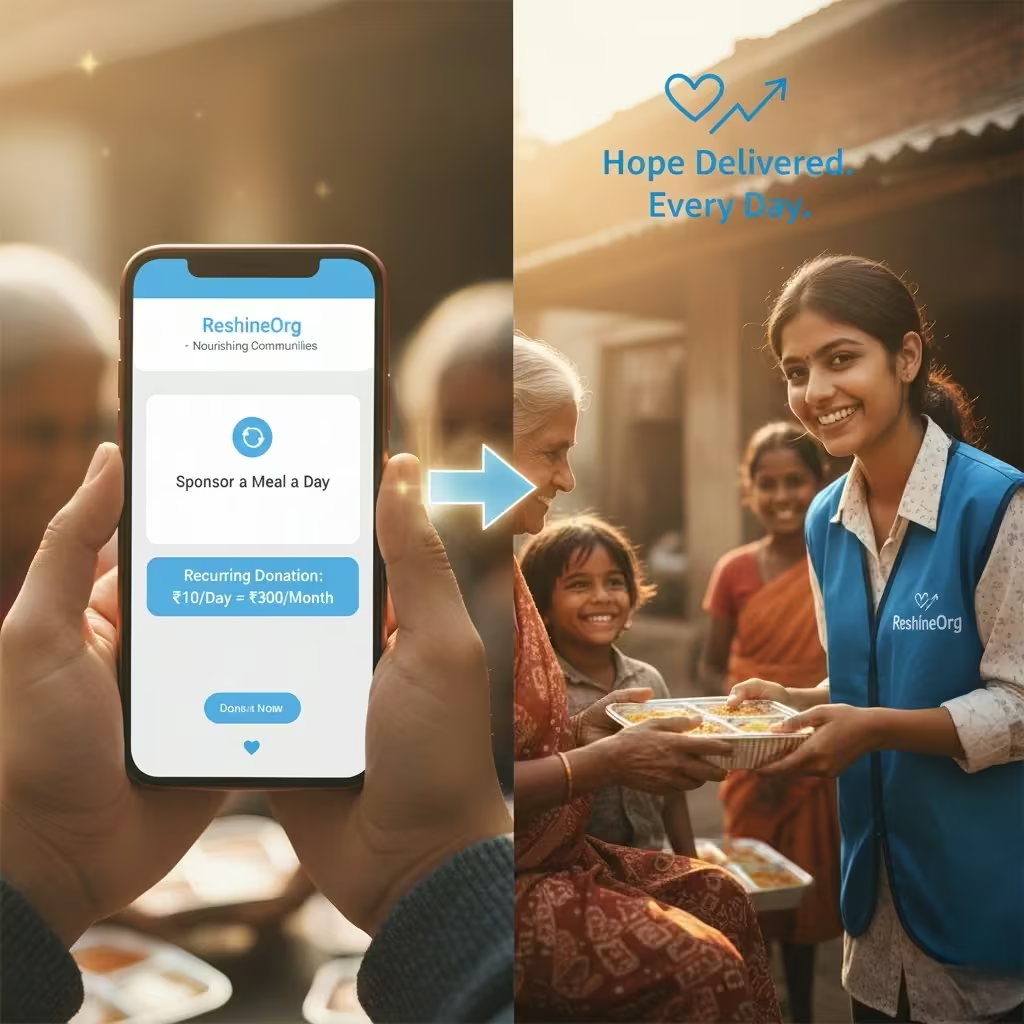
Donate Financially
Cash donations are the most flexible form of support. They allow organizations to cover food costs, kitchen operations, transportation, and staff salaries.
Akshaya Patra: Donating ₹1,500 can feed a child for a full academic year. Monthly donations are also available for individuals and corporations. NRI donors and foreign nationals can donate through wire transfer .
Annamrita Foundation: The foundation accepts donations through United Way Mumbai. You can support mid-day meals for government school students to boost attendance and nutrition .
Explore Corporate and CSR Partnerships
Many NGOs partner with corporates for CSR initiatives. Some offer community and corporate-sponsored meal initiatives like Tithi Bhoj and Khichdi Drives . If your company has a CSR program, consider proposing a partnership with a mid-day meal NGO.
Volunteer Your Time
NGOs need volunteers for various activities:
- Meal packaging and distribution
- Awareness campaigns
- Monitoring and reporting
- Kitchen assistance
Spread Awareness
One of the most valuable contributions is raising awareness. Share information about mid-day meal programs with friends, family, and colleagues. The more people know about these programs, the more support they attract.
The Future: Extending Mid-day Meals to Breakfast
Several states have proposed extending PM POSHAN to include breakfast provisions in government and government-aided schools . These states include Rajasthan, Kerala, Chhattisgarh, Sikkim, Lakshadweep, Gujarat, and Delhi .
Why Breakfast Matters
The National Education Policy 2020 notes that “the morning hours after a nutritious breakfast can be particularly productive for the study of cognitively more demanding subjects” . Studies show that a morning meal boosts continuity of nutrition while lifting attendance, attention, and equity in classrooms .
Tamil Nadu’s Example
Tamil Nadu’s breakfast programme, launched in 2022, expanded to reach about 24 lakh students, with commensurate improvements in attendance and health outcomes . The logic is simple: nourished children learn better.
Cost Considerations
The Centre estimates the additional cost of a nationwide breakfast rollout at around Rs 6,000 crore annually . The Ministry of Education has reportedly estimated the cost at about Rs 4,000 crore . While substantial, this cost is outweighed by the benefits, especially when compared with the downstream burdens of remedial education, healthcare, and lost productivity .
Conclusion
Mid-day meal programs are one of India’s most successful interventions for fighting hunger and promoting education. They keep children in school, nourish their bodies, and give families hope.
NGOs play an indispensable role in implementing these programs. They bring efficiency, quality control, and reach that the government alone cannot provide. But they face real challenges, including funding gaps and logistical hurdles.
Your support can make a difference. Whether through financial donations, volunteering, or raising awareness, you can help ensure that no child learns on an empty stomach.
Your Next Step: Support a Mid-day Meal Program Today
Ready to make a difference? Partner with organizations that nourish children’s futures.
Donate to Support Mid-day Meals and Make Your Impact Gift Now
Request Our “Mid-day Meal Donor Guide” for more resources and partner information.
Share This Guide with friends and colleagues who care about children’s nutrition.
Give wisely. Nourish children. Build futures.