

- Why Cold Storage Matters for Food Security in India
- The Scale of India's Post-Harvest Challenge
- How Cold Storage Saves Food and Lives
- India's Cold Storage Infrastructure: The Numbers
- How Cold Storage Helps Farmers
- The Rourkela Model: Cold Storage in Action
- Government Initiatives Supporting Cold Storage
- How Reshine Org Uses Cold Storage in Its Mission
- Why Donors Should Support Cold Storage
- How You Can Support Cold Storage Solutions
- Conclusion: Cold Storage, Food Security, and You
Why Cold Storage Matters for Food Security in India
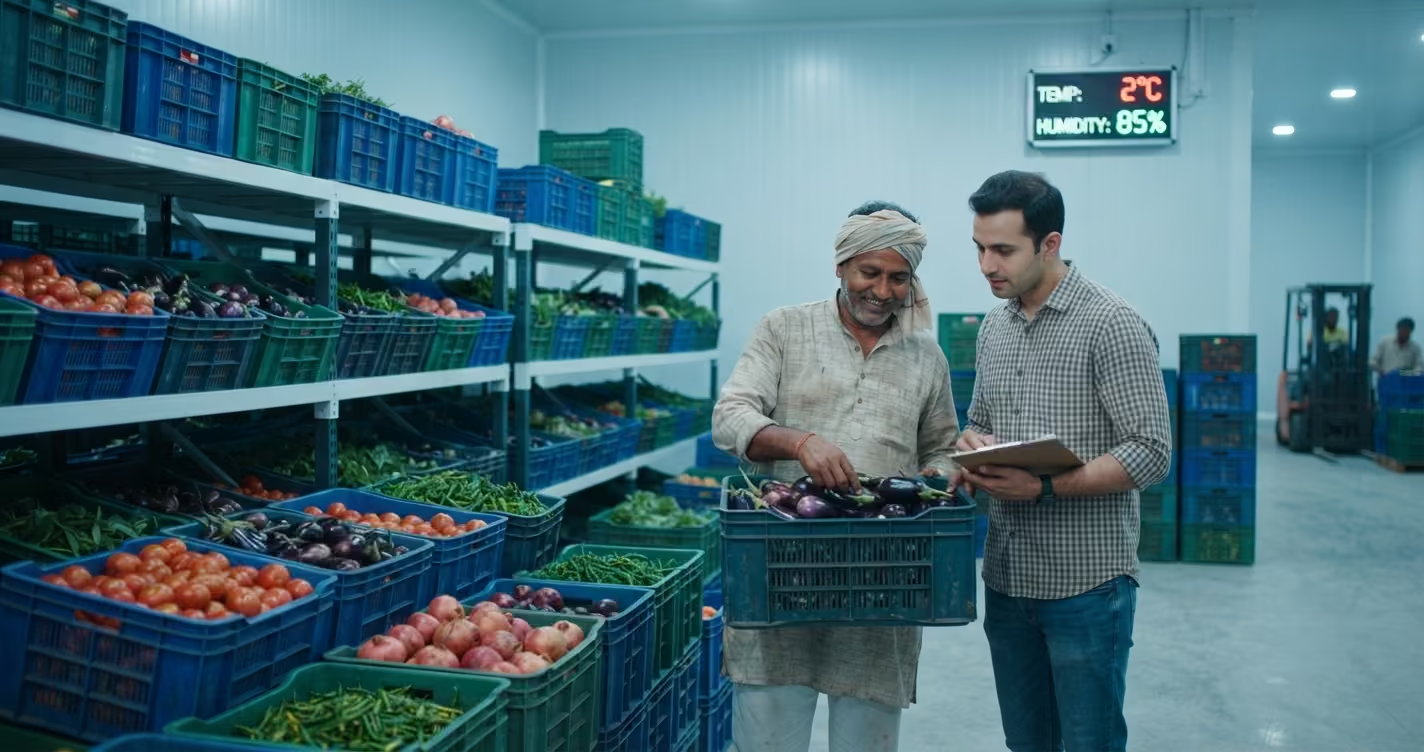
Every year, India produces enough food to feed its population. Yet millions go hungry. The gap between harvest and plate is filled with waste. Cold storage matters because it bridges this gap. It preserves food from farm to fork. It protects farmers’ incomes. It ensures families have access to nutritious food year-round.
This is where cold storage becomes critical. Without proper preservation, nearly one-third of all food produced globally goes to waste . In India, post-harvest losses remain a significant challenge, particularly for perishable commodities .
At Reshine Org, we understand this connection intimately. We operate a food bank in Bidar, Karnataka, rescuing surplus food that would otherwise go to waste. Cold storage is the backbone of our food distribution network . This guide will help you understand why cold storage matters for food security and how your support can make a difference.
The Scale of India’s Post-Harvest Challenge
India’s agricultural bounty is impressive. The country recorded an all-time high foodgrain production of 353.96 million tonnes in 2024-25 . Yet significant losses occur between harvest and consumption.
Research indicates that considerable losses occur throughout the supply chain . These losses happen at every stage:
- Harvesting
- Handling
- Transport
- Storage
- Processing
The consequences are severe. Farmers see reduced incomes. Consumers face higher prices. National food security is undermined .
A 2020 evaluation study by NABARD Consultancy Services (NABCONS) highlighted a critical finding: interventions under cold storage schemes resulted in significant reduction in wastages, particularly in fruits & vegetables, dairy, and fisheries sectors . This evidence confirms what food security experts have long known: cold storage matters immensely.
How Cold Storage Saves Food and Lives
Cold storage does more than keep food cold. It creates an uninterrupted “cold chain” from farm gate to retail outlet . This chain preserves food quality and nutritional value.
Preserving Perishables
Perishable commodities need temperature-controlled environments. These include :
- Fruits and vegetables
- Dairy products
- Meat and poultry
- Fish and marine products
Without cold storage, these items spoil within days. With proper preservation, their shelf life extends dramatically. This means less waste and more food available for consumption.
Enabling Year-Round Availability
Cold storage ensures essential commodities remain available throughout the year . This stabilizes markets and prevents price spikes. Consumers can access nutritious food regardless of harvest seasons.
Strengthening the Public Distribution System
The Public Distribution System (PDS) depends on buffer stocks. Cold storage maintains these stocks in good condition . This ensures food reaches vulnerable populations when they need it most.
India’s Cold Storage Infrastructure: The Numbers
India has made significant progress in cold storage capacity. Yet major gaps remain.
Existing Capacity
As of June 30, 2025, India operates 8,815 cold storages with a combined capacity of 402.18 lakh metric tonnes (LMT) . This capacity helps preserve perishable products nationwide.
The Food Corporation of India (FCI) and state agencies manage a combined covered and Cover and Plinth (CAP) storage capacity of 917.83 LMT for central pool grains . This infrastructure supports the country’s strategic grain reserves.
Growth Trajectory
India’s cold storage capacity has shown steady growth. The National Centre for Cold-Chain Development (NCCD) projects a total capacity of nearly 440 LMT by 2031, representing a compound annual growth rate of approximately 2.2% .
The Refrigerated Transport Gap
Despite this growth, refrigerated transport remains significantly underutilized. Approximately 10,000 reefer vehicles operate in India, against an estimated need of at least 62,000 units . This gap of over 80% means much food still travels without proper temperature control.
NCCD estimates the number of reefer vehicles might increase to approximately 33,000 by 2031 . But this still leaves a substantial deficit. For a country of India’s size and population, this represents a significant barrier to food security.
How Cold Storage Helps Farmers
Cold storage is not just about preserving food. It transforms farmers’ economic realities.
Preventing Distress Sales
Without storage, farmers must sell their produce immediately after harvest. This forces them to accept whatever price buyers offer. Cold storage gives farmers options. They can wait for better prices .
Enabling Better Price Realization
The Rourkela Cold Room Project demonstrates this clearly. Solar-powered cold rooms helped farmers reduce distress selling of vegetables at below-market prices . Farmers could store surplus produce and sell when demand was higher.
Supporting Women Farmers
Women’s cooperatives managing cold rooms experienced significant economic gains. Participating women’s cooperatives saw monthly earnings increase from ₹18,000 to ₹90,000 . Over 96% of participating women reported feeling empowered in financial decisions .
The Rourkela Model: Cold Storage in Action
One of India’s most successful cold storage initiatives is the Rourkela Cold Room Project in Odisha. This project offers a blueprint for how cold storage matters in real communities.
What the Project Achieved
The project built five solar-powered cold storage units in strategic market locations . These facilities offer short-term, temperature-controlled storage for fruits and vegetables.
Results have been remarkable:
- 31% reduction in food waste
- Up to fivefold increase in cooperative revenue
- Over 40 women gained formal employment
- 96.2% of women felt empowered in household financial decisions
How It Works
Women’s cooperatives manage the cold rooms . They receive training in technical operations, business management, and financial literacy. The facilities use solar panels for sustainable power.
Electric rickshaws provide eco-friendly transportation between cold rooms and markets . This completes the cold chain from storage to consumer.
Beyond Storage: Building Ecosystems
The cold rooms became more than storage facilities. They evolved into Common Facility Centres where women sell organic products directly to customers . They also coordinate bulk supply to hotels, schools, and institutional buyers. Home delivery services using electric rickshaws further expand access.
This ecosystem approach demonstrates why cold storage matters far beyond simple preservation. It creates economic opportunity and community resilience.
Government Initiatives Supporting Cold Storage
The Indian government recognizes that cold storage matters for national food security. Several schemes support cold chain infrastructure development.
Integrated Cold Chain and Value Addition Infrastructure (ICCVAI)
This scheme operates under the Pradhan Mantri Kisan Sampada Yojana (PMKSY) . Its goal is to build a seamless cold chain from farm gate to retail outlet .
Key Achievements:
- 395 integrated cold chain projects approved since 2008
- 291 projects completed and operational
- 25.52 LMT preservation capacity created annually
- 114.66 LMT processing capacity created annually
- 1,74,600 jobs generated
Financial Support:
- 35% subsidy on eligible project costs in general areas
- 50% subsidy in difficult areas and for SC/ST, FPOs, SHGs
- Maximum ₹10 crore per project
Agriculture Infrastructure Fund (AIF)
Launched in 2020, AIF provides a corpus of ₹1 lakh crore . It facilitates creation of post-harvest management assets, including cold storages and warehouses . Beneficiaries can access collateral-free loans up to ₹2 crore with 3% interest subvention .
Mission for Integrated Development of Horticulture (MIDH)
MIDH provides financial assistance for constructing, expanding, and modernizing cold storages up to 5,000 MT capacity . It offers credit-linked back-ended subsidies of 35% in general areas and 50% in North Eastern and hilly states .
National Horticulture Board (NHB) Initiative
NHB supports cold storage for horticulture products . The Capital Investment Subsidy scheme provides similar subsidies for capacities ranging from 5,000 MT to 20,000 MT .
Recent Expansion: Food Irradiation
In July 2025, the government approved an additional ₹1,920 crore for PMKSY . This includes ₹1,000 crore to support 50 multi-product food irradiation units . Food irradiation uses ionizing radiation to preserve food, extend shelf life, and reduce post-harvest losses .
How Reshine Org Uses Cold Storage in Its Mission
At Reshine Org, cold storage is essential to our food rescue operations . We collect surplus food from restaurants, supermarkets, and events. Without proper preservation, this food would spoil quickly.
Our Cold Chain Process
Food Pickup: Volunteers trained in food handling collect surplus food . They follow strict safety protocols to maintain quality.
Sorting and Quality Check: Food is sorted based on perishability. Expired or unsafe items are discarded immediately .
Storage and Transportation: Perishable items are stored in hygienic containers and transported quickly. Cold storage maintains freshness for items that need temperature control .
Distribution: Food is categorized and sent to community centers, shelters, and government hospitals . Proper tracking ensures fair and efficient delivery.
Our Impact
Through this cold chain approach, Reshine has served over 1.2 million meals during crisis response . Our hunger alleviation program serves over 600 meals daily to government hospitals, slum communities, and shelters .
Cold storage enables us to rescue food that would otherwise contribute to greenhouse gas emissions. Studies show food bank donations significantly reduce carbon emissions. Every kilogram of food rescued means less methane from landfills.

Why Donors Should Support Cold Storage
Understanding why cold storage matters helps you make better giving decisions. Your donation to cold storage infrastructure creates multiple impacts.
Multiplied Impact
Every rupee invested in cold storage generates returns across multiple dimensions:
- Food security: More food reaches those who need it
- Farmer incomes: Better prices through storage options
- Environment: Less food waste means lower emissions
- Nutrition: Preserved food retains nutritional value
Strategic Giving
Cold storage is infrastructure. It creates lasting impact rather than one-time relief. A cold room built today serves farmers and communities for decades.
Supporting organizations like Reshine ensures your donation connects to this critical infrastructure. Your contribution helps maintain our cold chain and expand our food rescue capacity.
Alignment with Government Priorities
The government is investing heavily in cold storage. The PMKSY allocation of ₹6,520 crore reflects this commitment . Private and philanthropic support complements these efforts and accelerates progress.
How You Can Support Cold Storage Solutions
Donate to Food Rescue Organizations
Organizations like Reshine need cold storage to function effectively. Your donation helps maintain and expand this critical infrastructure.
Donate to Reshine Org to support our cold chain operations . Every contribution helps us rescue more food and reach more communities.
Support Farmer Cooperatives
Organizations helping farmers access cold storage deserve support. Women’s cooperatives in Rourkela demonstrated how cold rooms transform communities . Your donation can replicate this model elsewhere.
Fund Specific Cold Storage Projects
Consider funding a specific cold storage project in your community. This tangible investment creates visible, lasting impact.
Advocate for Policy Support
Raise awareness about why cold storage matters. Encourage businesses to invest in cold chain infrastructure. Support policies that make cold storage accessible to small farmers.
Conclusion: Cold Storage, Food Security, and You
Cold storage is not a luxury. It is a necessity for food security. Without it, food spoils, farmers lose income, and families go hungry.
India has made progress. Nearly 9,000 cold storages operate across the country . Government schemes support expansion. But gaps remain, especially in refrigerated transport.
Your support matters. Whether through donations, advocacy, or community action, you can help close these gaps. Every rupee invested in cold storage creates ripple effects that strengthen food security for years to come.
At Reshine Org, we see the difference cold storage makes every day. It enables us to rescue food and feed families. It transforms surplus into sustenance. It turns waste into opportunity.
Your Next Step: Support Cold Storage Solutions
Ready to make a difference? Partner with Reshine Org to support cold storage and food security.
Donate to Reshine and Strengthen Our Cold Chain and Make Your Impact Gift Now
Request Our “Cold Storage and Food Security” Fact Sheet.
Share This Guide with friends who want to reduce food waste.
Give wisely. Reduce waste. Feed families. Protect the planet.